Why Improve Your Resume: 75% Fewer ATS Rejections

Your resume is your ticket to landing interviews, but 75% never reach human eyes. In a job market with 7.2 million U.S. openings yet 180 applicants competing per position, improving your resume isn't optional. It's the difference between getting lost in the crowd and securing that interview call. This guide reveals data-backed strategies to transform your resume into an interview-generating machine.
Key Takeaways
| Point | Details |
|---|---|
| ATS filters reject 75% of resumes | Most applicants never reach human reviewers due to formatting and keyword issues |
| Tailoring increases interviews by 40% | Customizing resumes to match job descriptions dramatically improves success rates |
| Recruiters scan for just 7 seconds | First impression happens in seconds, making clear presentation critical |
| Quantifiable achievements triple interviews | Measurable results demonstrate value and attract recruiter attention |
| Proper formatting reduces rejection by 73% | Clean structure and error-free content prevent automatic elimination |
The Resume's Critical Role in Today's Job Market
The 2026 U.S. job market presents a paradox. With 7.2 million job openings available, you'd think landing interviews would be straightforward. The reality? About 180 applicants compete per job opening, with only 5% securing interviews.
Your resume serves as the primary gatekeeper in this competitive landscape. It's not just a document listing your experience. It's your first impression, your marketing tool, and often the sole factor determining whether you advance to the next stage. Recruiters use resumes to make rapid decisions about candidate fit, qualifications, and potential value to their organization.
Consider these market realities:
- Hundreds of applicants submit resumes for single positions at small and medium-sized businesses
- Most companies use automated systems as the first screening layer
- Human recruiters only review resumes that pass initial filters
- Strong resume presentation influences every subsequent hiring decision
Without a compelling, optimized resume, even highly qualified candidates disappear into the application void. Your skills and experience matter little if your resume can't communicate them effectively within seconds.
How ATS Systems Impact Your Resume's Success
Applicant Tracking Systems (ATS) are software platforms companies use to manage job applications. These systems scan, parse, and rank resumes before any human sees them. Understanding how ATS works is essential because 75% of resumes get rejected at this automated stage.
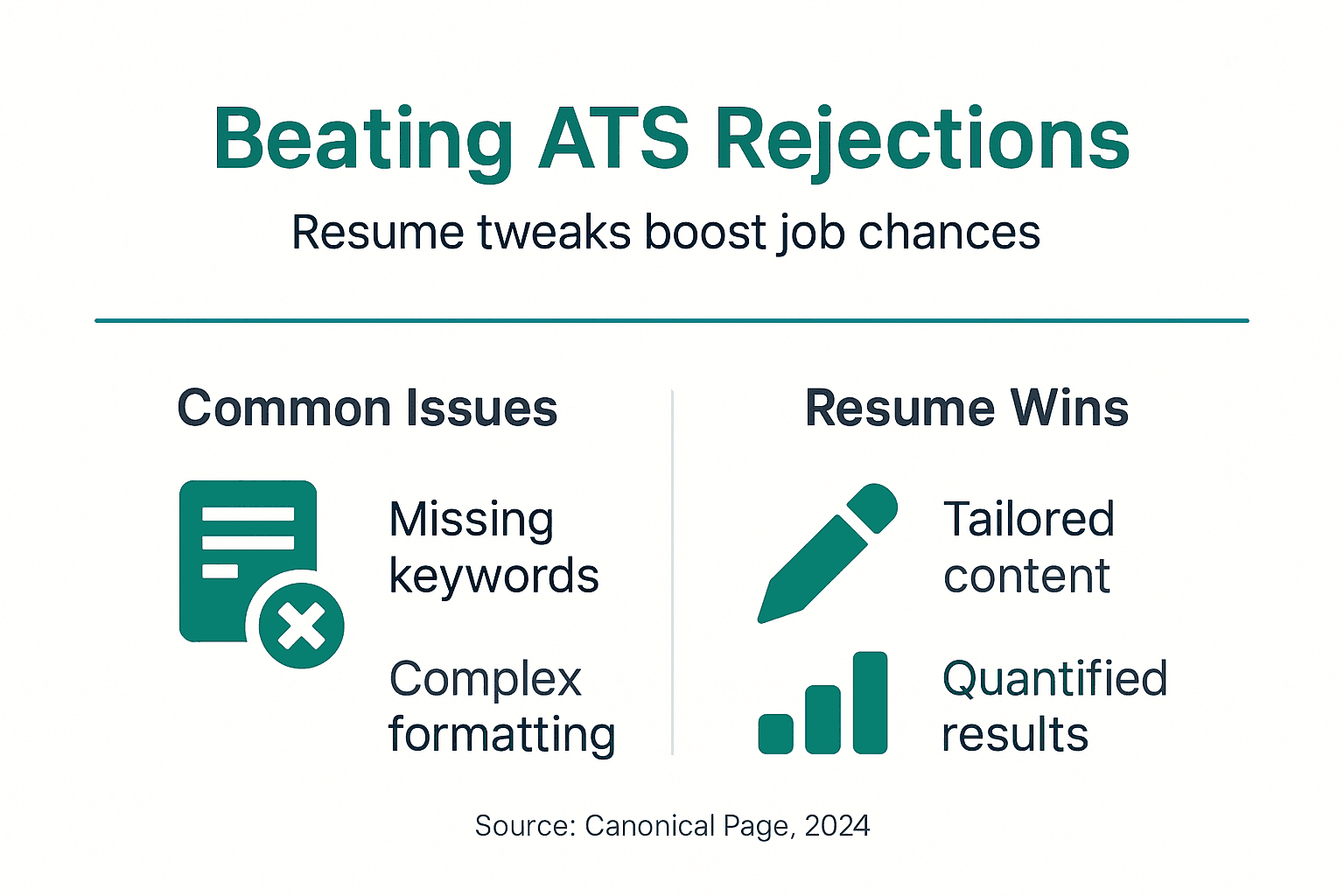
ATS software searches for specific keywords matching job descriptions, analyzes formatting, and scores candidates based on relevance. When your resume lacks target keywords or uses incompatible formatting, it gets ranked poorly or filtered out entirely. Common rejection triggers include graphics, tables, unusual fonts, headers with contact information, and missing standard section labels.
The automation trend is accelerating. 83% of companies plan to use AI for resume screening by late 2025, meaning even more resumes face algorithmic evaluation before human review.
To optimize your resume for ATS compatibility:
- Use standard section headings like "Work Experience" and "Education"
- Include keywords from the job description naturally throughout your content
- Stick to simple formatting without graphics, text boxes, or complex tables
- Save as .docx or PDF formats unless specified otherwise
- Avoid headers and footers for critical information
Pro Tip: Run your resume through a free ATS resume checker to identify compatibility issues before applying. Small formatting adjustments can dramatically improve your pass rate.
Understanding how ATS systems work gives you a significant advantage. You're not gaming the system — you're ensuring your qualifications get properly recognized and communicated.
What Recruiters Actually Do During Resume Reviews
Once your resume passes ATS screening, it reaches a human recruiter. Here's the challenge: recruiters spend approximately 7 seconds on their initial review. In those brief moments, they form impressions that determine whether your resume gets serious consideration or immediate rejection.

Recruiters focus primarily on the top third of your resume — your professional summary, key skills section, and most recent work experience. They scan for relevant keywords, notable achievements, and red flags like employment gaps or formatting errors. Clear visual hierarchy guides their eyes to the most important information quickly.
Presentation quality matters enormously. Poor formatting leads to rejection by 73% of hiring managers, regardless of qualifications. Grammar mistakes, inconsistent spacing, dense text blocks, and cluttered layouts signal lack of attention to detail.
Optimize your resume for quick scanning:
- Use bullet points instead of paragraphs for achievements
- Create clear section divisions with consistent formatting
- Lead with strong action verbs and quantifiable results
- Maintain plenty of white space for visual breathing room
- Keep font size between 10–12 points for readability
Pro Tip: Print your resume and see what catches your eye in 7 seconds. Those elements should be your strongest selling points. If they're buried, restructure immediately.
Tailoring your resume for each application improves both ATS compatibility and recruiter appeal. Generic resumes fail to capture attention because they don't address specific role requirements.
Why Quantifiable Achievements and Tailoring Matter
The difference between resumes that generate interviews and those that don't often comes down to two factors: quantifiable achievements and job-specific tailoring. These elements can triple your interview chances by demonstrating concrete value and relevance.
Quantifiable achievements answer the question every recruiter asks: "What results did you deliver?" Instead of saying "managed a team," specify "led 8-person team to 34% productivity increase over 6 months." Numbers provide context, scale, and proof of impact.
Tailoring your resume to match job descriptions increases interview likelihood by 40% or more. When you align your keywords, skills, and achievements with what employers specifically request, you signal perfect fit.
To incorporate quantifiable achievements effectively:
- Review past roles and identify measurable outcomes (revenue, efficiency, cost savings, growth percentages)
- Use the format: Action verb + specific task + quantifiable result
- Include timeframes to demonstrate efficiency
- Focus on achievements, not just duties performed
- Adapt metrics to match what each target role values most
| Generic Statement | Quantified Achievement |
|---|---|
| Improved customer satisfaction | Increased customer satisfaction scores from 3.2 to 4.7 out of 5 within 8 months |
| Managed social media accounts | Grew Instagram following by 156% and engagement by 89% in one year |
| Reduced operational costs | Cut departmental expenses by $47,000 annually through process optimization |
Resume tailoring involves more than swapping keywords. You're strategically highlighting the experiences and achievements most relevant to each specific opportunity.
Common Misconceptions About Resume Improvement
Several persistent myths lead job seekers astray. Understanding what actually matters versus what doesn't saves time and improves results.
Myth: ATS automatically rejects all imperfect resumes. Reality: Most ATS systems rank resumes rather than outright reject them. Poor ranking lowers your chances significantly, but humans still review many applications. The goal isn't perfection — it's optimization to rank as high as possible.
Myth: Longer resumes demonstrate more experience and value. Reality: Ideal resume length sits between 475–600 words. Longer documents lose recruiter attention during the critical 7-second scan. Concise, impactful content outperforms exhaustive lists every time.
Myth: Grammar and formatting don't affect ATS scoring. Reality: While ATS primarily scans for keywords, 73% of hiring managers reject resumes with errors or poor formatting. These issues impact both automated parsing and human perception.
| Myth | Fact |
|---|---|
| Graphics make resumes stand out | Graphics confuse ATS and often cause parsing errors |
| One resume works for all applications | Tailored resumes increase interview rates by 40%+ |
| Education matters most | Recent, relevant experience and achievements drive hiring decisions |
| More pages show more qualifications | Recruiters prefer concise, focused content that respects their time |
Focus on evidence-based strategies rather than assumptions. The 2026 job search checklist provides current, data-backed guidance for navigating today's hiring landscape effectively.
Practical Tips and Tools for Improving Your Resume
Improving your resume doesn't require starting from scratch. Strategic refinements using the right approach and tools can transform your application materials quickly.
Follow this framework for resume optimization:
- Analyze target job descriptions and extract 10–15 key skills and requirements
- Compare your current resume against these requirements and identify gaps
- Revise your professional summary to mirror top priorities from the job posting
- Reframe work experience bullets to emphasize relevant achievements with metrics
- Ensure keyword density matches job description without awkward repetition
- Format consistently using standard section headers and simple styling
- Include your LinkedIn profile URL to provide additional context and credibility
Optimal resume length targets 475–600 words. This range provides enough detail to demonstrate qualifications without overwhelming reviewers. Every sentence should add value — cut filler phrases and redundant information ruthlessly.
Including your LinkedIn profile or professional page link gives recruiters easy access to additional information. It also demonstrates digital presence and provides context beyond the resume's limited space. Ensure your online profiles match and expand upon resume content rather than contradicting it.
AI-powered tools can accelerate the improvement process significantly. Use ATS resume analysis tools to identify formatting issues and keyword gaps before submitting applications. An ATS-compatible resume builder ensures proper structure from the start. AI tools for resume improvement help optimize content for both algorithms and human readers.
Pro Tip: Save your master resume with all experiences and achievements, then create tailored versions for different job types. This approach maintains consistency while allowing strategic emphasis shifts based on role requirements.
Effectively Improving Your Resume Increases Job Success
The improvements outlined in this guide aren't theoretical — they produce measurable results in real job searches. Optimized resumes increase interview chances by up to 3x while reducing ATS automatic rejection by 75%.
Consider what these improvements mean practically. Instead of applying to 100 positions and hearing nothing, you might receive 15–20 interview invitations. That's the difference between frustrating job search stagnation and meaningful progress toward career goals.
Better resumes improve recruiter engagement throughout the hiring process. When your application clearly demonstrates fit, relevance, and value, hiring managers approach interviews with positive expectations. You've already made a strong first impression before any conversation begins.
Continuous resume refinement matters because job markets, industry requirements, and your own qualifications evolve constantly. Review and update your resume quarterly, even when not actively job searching. Add new achievements, refresh keywords based on industry trends, and ensure formatting remains current.
The competitive edge you gain in the 2026 job market through resume optimization compounds over time. Each improvement increases your visibility, strengthens your positioning, and expands your opportunities.
Boost Your Job Prospects with Canonical Page Tools
Ready to transform your resume and triple your interview rate? Canonical Page provides the exact tools you need to implement everything discussed in this guide.
Start with the free ATS resume checker and analyzer to identify issues blocking your success. You'll discover exactly which formatting problems and keyword gaps are limiting your visibility. Then use the ATS-compatible resume builder to create optimized documents that pass automated screening and impress human recruiters.
Canonical Page combines your resume and professional profile into one powerful platform. Build once and get an ATS-compatible PDF for applications plus a live personal page at your own URL that's always current. AI-powered professional profiles write and improve your content, match you to job descriptions, and even generate tailored cover letters.
Start building your profile for free and ensure your applications reach human decision-makers.
Frequently Asked Questions
What is the most common reason resumes fail ATS?
Missing keywords that match the job description causes most ATS failures. When your resume doesn't include specific skills, technologies, or qualifications mentioned in the posting, the system ranks you low or filters you out. Poor formatting like graphics, tables, or unusual fonts also prevents proper parsing.
How long should a resume be in 2026?
Aim for 475–600 words or 1–2 pages depending on experience level. Entry-level candidates should stick to one page, while professionals with 10+ years can use two pages if the content remains relevant and impactful. Recruiters prefer concise, focused resumes that respect their limited review time.
Can AI tools guarantee I pass ATS?
No tool guarantees ATS success because each system uses different algorithms and criteria. However, AI-powered resume analyzers dramatically improve your odds by identifying formatting issues, suggesting relevant keywords, and optimizing content structure. They eliminate common mistakes that cause automatic rejection.
How often should I update my resume?
Update your resume quarterly, even when not job searching. Add new achievements, skills, and certifications as you acquire them. Before each application, tailor your resume specifically to that job description. Regular updates ensure accuracy and make customization faster when opportunities arise.
Does including LinkedIn really help?
Yes, including your LinkedIn URL provides recruiters easy access to additional context about your background, recommendations, and professional network. It demonstrates digital presence and allows you to expand beyond resume space limitations. Ensure your LinkedIn profile matches and complements your resume content for consistency.
Related reading:
Ready to create your professional page?
Build your ATS-compatible profile in under 10 minutes.
Get started for free